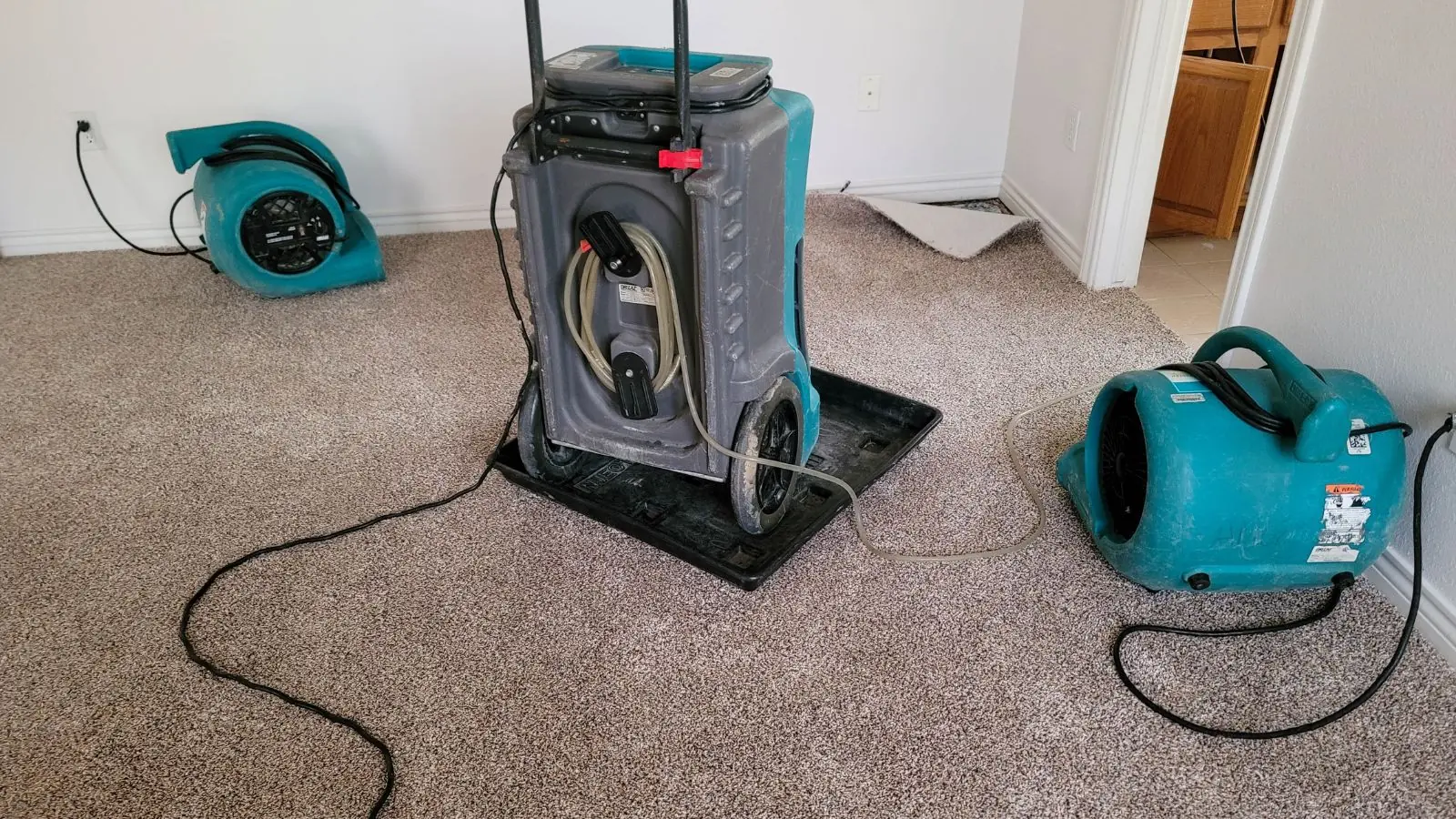
The honest range
For a typical clean-water loss, such as a supply line or washer hose, structural drying usually runs about three to five days. Thick materials such as hardwood, plaster, subfloor and wall cavities with insulation can take longer. Serious losses, or ones where drying started late, can run a week or more.
These are general industry ranges, not a promise. A kitchen with one soaked cabinet base and a living room carpet that sat wet over a weekend are different jobs, and the crew will know which one you have only after taking readings. Anyone who gives you an exact number on the phone is guessing.
What sets the clock
Water category
Clean water from a supply line dries the same as any water, but contaminated water means removing porous materials first, which changes the whole plan.
How long it sat
Water that has soaked into drywall, framing and flooring for days takes more effort to pull out than water caught the same afternoon.
Materials involved
Carpet and pad, laminate, hardwood, drywall and plaster release water at different speeds. Dense hardwood is the slowest.
Area and layers
Wet insulation inside a wall, or water that traveled under flooring or cabinets, extends the job beyond what you can see.
Indoor humidity and airflow
Humid indoor air holds less additional moisture, so drying slows. Dehumidifier capacity, airflow and a closed-off space all speed the job.
Want a drying plan for your own home?
Tell us what got wet and when. We size the equipment to the readings and explain the scope and price before work starts.
What each machine is doing
| Equipment | Job | What you notice |
|---|---|---|
| Extraction unit | Pulls bulk water out of carpet, pad and hard floors | Loud, short visit at the start |
| Air movers | Blow air across wet surfaces to move moisture off them | Steady noise and warm air in the room |
| LGR dehumidifier | Pulls moisture out of the air so surfaces can keep releasing water | Warm exhaust, a drained hose or tank |
| Moisture meter | Reads moisture in drywall, wood and subfloor | A tech touching probes to walls and floors |
| Thermal imaging camera | Shows cooler wet zones behind finishes | Pictures of the walls and ceiling |
| Wall-cavity drying setup | Moves dry air through holes opened in the wall | Small ports along baseboards |
LGR stands for low grain refrigerant, a type of dehumidifier built to keep pulling moisture from air that is already fairly dry. Air movers alone can push damp air around a room without ever removing it, which is why one without the other disappoints.
How a drying job is tracked, day by day
Day 0: map and extract
The crew finds the source of water, extracts standing water, takes moisture readings and a thermal image, and sets a dry standard from unaffected material.
Day 1: set up equipment
Air movers and LGR dehumidifiers are placed to match the wet area. Wet pad or damaged materials that cannot dry in place are removed.
Days 2 to 4: daily readings
Techs read the same spots each day, record the numbers and move or remove equipment. Numbers falling toward the dry standard means the plan works. Flat numbers mean something is still feeding moisture.
Final check: dry standard met
When the readings match the dry standard, equipment comes out. That is the end of drying, and the start of repair or rebuild.
Three common losses and how their drying differs
A washer hose on a tile or laminate floor
Water spreads fast under laminate and into the baseboard. Laminate often has to come up, because the boards swell and trap water, while tile itself is fine but the subfloor and wall bottoms need drying. Expect a few days with air movers along the baseboards.
A burst pipe inside a wall
Water runs down the cavity, soaks the insulation and pools on the bottom plate. Crews cut access openings, remove wet insulation and dry the cavity with directed air. Drywall can often be saved if it is caught quickly.
A roof leak through the ceiling
The ceiling drywall and insulation above take the hit. Wet insulation holds water for a long time, so it is usually removed. Drying then focuses on the framing and the ceiling below, with the roof repaired separately.
What to do while the drying equipment runs
Once machines are set, your habits decide whether the job finishes on schedule. These rules keep readings moving in the right direction.
- Leave the equipment running around the clock unless the crew tells you to pause it. Do not unplug a machine to run something else.
- Keep doors and closets in the drying zone as the crew arranged them, because air paths are part of the plan.
- Do not stack boxes against wet walls or cover vents and machine intakes.
- Do not use a space heater or portable cooling unit in the drying zone without asking the crew first.
- Tell the crew about new stains, smells or damp spots right away, even if they seem unrelated.
- Do not call the job finished until the crew shows you dry readings that match the unaffected reference material.
Why you should not shut it off early
The fans are loud and the dehumidifier warms the house. It is tempting to switch everything off after a day because the floor feels dry. Surface dryness comes first, and the moisture deep in the subfloor and wall bottom plates follows. Turning equipment off at that point leaves wet material sealed behind paint and flooring.
A moisture meter and a daily log protect you in two ways. They show the drying is working, and they give you a record to share with your insurer. If readings are not recorded, ask for them.
Can you rent the equipment and do it yourself?
We do not offer equipment rentals. For a small spill on a hard floor, a rented fan and household dehumidifier are fine. For a soaked wall or a wet subfloor, the question is not the machine but the measuring. Without a meter and a plan, a rental dries the air in the room while the wet material stays wet.
If the loss is larger than one wet spot, let a crew size the equipment. Our water mitigation work covers that planning, and the follow-on water damage repair starts once drying is done.
Mission Viejo notes: shutoffs, storms and flood coverage
Four water providers serve Mission Viejo, according to the city: El Toro, Moulton Niguel, Santa Margarita and Trabuco Canyon water districts. Which one applies to you depends on your address. Before a drying job, the first step is stopping the water, so find your main shutoff now and look at a bill to learn your district.
The National Weather Service reported that the February 4 to 8, 2024 storms brought 4 to 10 inches of rain to Orange County. A multi-day soaking like that can push water through roofs, windows and door thresholds, and drying after a storm leak depends on how long the wet insulation and drywall sat. Photograph and report the leak early.
If groundwater or street water entered your home, that is flood, which the California Department of Insurance says standard homeowners policies typically exclude. The city participates in the National Flood Insurance Program, and you can check your flood map on FEMA's Map Service Center. Drying is the same either way, but the coverage conversation is not.
Drying time questions
Does drying take longer in Mission Viejo during a rainy week?
It can. Drying depends on indoor humidity, and a damp, closed-up house slows evaporation. LGR dehumidifiers exist to control that humidity, and a crew will adjust equipment to the readings, not to the weather forecast.
How long until I can walk on the floor again?
Often the same day after extraction, but flooring that is lifted or removed has to stay out of the way. The crew will tell you which rooms to avoid and why.
Is it normal for the equipment to run for several days?
Yes. Typical structural drying runs several days, and it is checked daily. The equipment stays until readings meet the dry standard.
How do you know the walls are dry?
The crew compares moisture meter readings in the wet walls to readings in an unaffected wall of the same material. When they match, the wall is dry. A thermal camera supports the check but does not replace the meter.
Will mold grow while the area dries?
Mold needs moisture and time, and a commonly cited industry guideline is to start drying within 24 to 48 hours. Fast drying lowers the risk. Persistent odors or visible growth are a cue to call about mold remediation.
Do you also dry homes in Laguna Niguel and San Juan Capistrano?
Yes. Crews dispatched from Mission Viejo serve Laguna Niguel and San Juan Capistrano.