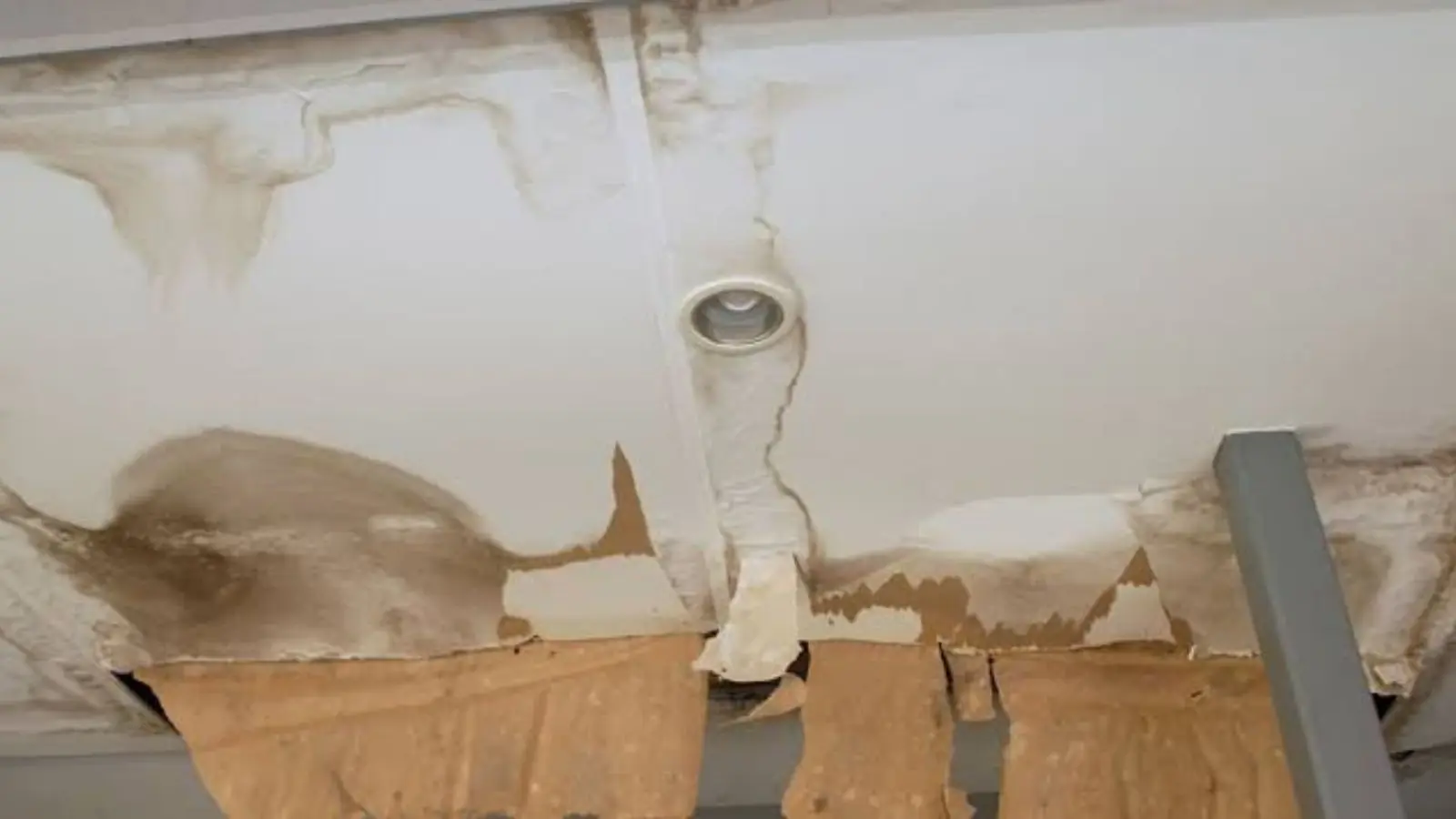
First 10 minutes: stop the water, then protect the room
A brown ring appears above the dining table on a Tuesday evening. Two days later it has doubled in size and the paint is blistered. That sequence is the most common ceiling call, and it means water is still arriving from above.
Your first job is to stop the source. If a bathroom or laundry room sits upstairs, shut off the supply valve at the fixture or the home's main water valve. If it is raining and the stain is on a top floor, the roof or an attic penetration is the likely path, and the fix has to wait for dry weather. Move furniture out from under the spot and put down plastic and a bucket.
Keep clear of the sag
A ceiling holding water is heavy. Do not stand under a bulge, and keep children and pets out of that room.
Check the lights and outlets
If water is dripping from a light fixture or fan, leave the switch alone. Cut that circuit at the breaker panel only if the panel is dry and you can reach it safely. If not, call 911 or your electric utility before anyone else.
Shut off the suspected source
Close the fixture valve, the water heater supply or the main valve. If the leak stops, you have found the category of problem, even before you find the exact pipe.
Photograph everything
Take wide and close photos with the date visible, and keep a short written log of what you did and when. Your insurer will ask for it.
Three leak sources, three different fixes
The stain looks the same no matter where the water starts. What changes is the repair, so tracing the source matters more than the patch. Use this table as a starting point, then confirm with a moisture meter before anything is closed up.
| Source | What it usually looks like | Timing clue | First move |
|---|---|---|---|
| Roof or attic leak | Stain near an exterior wall or under the attic, often with several spots | Shows up during or after rain, dries out between storms | Tarp or temporary roof repair, then dry the attic insulation |
| Upstairs plumbing | Stain below a bathroom, laundry or kitchen, may grow when fixtures run | Gets worse after showers, dishwasher or washer cycles | Shut off the fixture valve or main, then open the ceiling to find the pipe |
| AC condensate line or pan | Stain below a hallway air handler or attic unit, often a slow drip | Worsens on hot days when the system runs hard | Turn the system off at the thermostat, clear or replace the line |
| Water heater or supply line | Sudden wet patch, sometimes with a visible drip | Appears without rain or fixture use | Shut off the heater supply and the main valve |
Condensate lines are the quiet culprit. Air conditioners pull water out of humid air and send it to a drain, and a clogged line backs that water into the drain pan and over the edge. If the stain follows hot weather, switch the system off before it keeps feeding the leak.
Ceiling sagging or dripping now?
Call the 24/7 line. A crew can explain scope and price before work starts, and same-day response is available when schedules allow.
Stain, bubble or sag: how serious is it?
A flat brown stain, dry to the touch
This is often an old leak that has stopped. Mark the edge with a pencil and check again after the next rain and the next day of heavy fixture use. If the ring grows, water is still active and a moisture reading is worth more than any paint.
Bubbling or peeling paint
Paint bubbles when water collects behind the film. The drywall paper beneath is wet and may be softening. Do not scrape it off and repaint, because wet drywall under fresh paint hides mold and keeps getting weaker.
A sag, a bulge or a crack along the seam
Gypsum board loses strength fast when it is soaked. A sag means the panel is carrying water weight and its paper face is failing. A ceiling that has dropped even an inch can come down with little warning, so treat every sag as urgent.
When a ceiling can actually collapse
Collapse is rare but real. It happens when a slow leak soaks insulation sitting on top of the drywall, or when a burst pipe pours water into the cavity over hours. Wet insulation is heavy, and the screws or nails holding the board can pull through softened paper.
The warning signs are a visible belly in the ceiling, new cracks that appear overnight, water dripping steadily from one spot and a dull thud or crackle overhead. If you see any of these, leave the room and call our 24/7 line for emergency water removal. A collapsed ceiling in a bedroom or hallway also means insulation, plaster dust and possibly Category 2 water on the floor and furniture.
Draining a bulge, only if it is safe
If a ceiling is ballooning with water, a controlled release can prevent a worse failure. Do this only when there is no light fixture, fan or wiring under the bulge, the panel is not cracked wide open, and you can stand to the side with eye protection. If any of that is unclear, stay out and call.
Place a bucket under the lowest point of the bulge, with plastic sheeting below it. Use a screwdriver to make one small hole at the lowest point of the bulge, not the center of the stain, and let the water run into the bucket. Do not widen the hole. Leave the rest of the board in place and let a restoration crew decide what comes out.
What restoration crews do overhead
A crew starts by mapping the wet area with a moisture meter and a thermal imaging camera, which shows cooler wet patches behind paint. Wet drywall and insulation are cut out in clean sections, usually a little beyond the stained edge, so the joists and cavity can dry.
Air movers and LGR dehumidifiers then run until readings return to normal. Drying often takes a few days. After that, drywall is replaced, taped, textured to match and painted. Ask any company whether its crews work to the ANSI/IICRC S500 water damage standard, and ask for the scope and price explained before work starts.
Mission Viejo notes: why overhead leaks show up here
Census-based housing data compiled for the region shows that roughly two-thirds of Mission Viejo homes were built between 1970 and 1989. Water heaters, supply lines and original roofing from that era are all candidates when a stain appears. If your house is in that group, a water heater or old supply line is worth checking early.
The same data shows about 17 percent of homes are multifamily, which makes upstairs-neighbor leaks a real scenario for condos and townhomes. Tell your HOA or building manager at once, and photograph the damage before anyone patches it.
The city lists four water districts for residents: El Toro, Moulton Niguel, Santa Margarita and Trabuco Canyon. Depending on your address, a leak before your meter is your district's problem and a leak after it is yours. Find your district on your water bill before you call. The nearest NOAA station normal, Laguna Beach, shows rain clustering from November through March, so roof leaks cluster in winter while dry-season stains point toward plumbing or AC lines.
The same overhead problems turn up in neighboring towns. Crews dispatched from Mission Viejo also work in Lake Forest and Laguna Hills, so if your stain is across the city line the process is the same.
Ceiling water damage questions
My ceiling stain appeared after a dry stretch in Mission Viejo. Is it still a roof leak?
Probably not. Rain in this area concentrates between November and March, according to the NOAA normal for the nearest station. A stain that appears in summer or early fall usually comes from plumbing, a water heater, or an AC condensate line, so check those first.
Can I just paint over a ceiling water stain?
Only after the source is fixed and the drywall is confirmed dry with a moisture meter. Stain-blocking primer covers color, but it does not dry wet gypsum or stop mold.
How long before mold can grow on a wet ceiling?
Mold needs moisture and time, and a ceiling that stays damp for several days is at risk. Dry it quickly and fix the water source first. If you see dark growth, a mold remediation crew can assess it. Health questions belong to a physician.
Will homeowners insurance cover a ceiling leak?
Sudden and accidental water damage is often covered, while gradual leaks and neglect often are not. Read your policy, take photos and ask your insurer. Flood is usually excluded from standard homeowners policies.
Do I need a permit to replace ceiling drywall?
The city's Building Services division can tell you whether your repair needs one. It handles applications and inspections online, so ask before the drywall goes up.
Can you help if the water also reached the wall or floor below?
Yes. Water travels down framing, so crews check walls and flooring under any ceiling leak. See our water damage repair page for what the rebuild includes.